Muscat Is the Last Exit.
The Plumb Line
Thursday, June 11
"Hold out on a deal, and watch what happens Thursday." That is the message Donald Trump sent Wednesday evening, per Bloomberg — more American strikes if Tehran hadn't moved by morning. The deadline he set was today.
Today is today. The wires are already running. The Financial Times reports Iran is now threatening to close the Strait of Hormuz. Bloomberg reports a tanker appears to have been attacked in the Gulf of Oman overnight — separate from the direct US-Iranian military exchange involving strikes on multiple Iranian targets. The New York Times is running a live feed titled "U.S.-Iran Strikes Risk Dangerous New Phase."
Yesterday's brief called the ceasefire "managed escalation with a legal cover layer." The cover layer is gone. What remains is the escalation.
Muscat Is the Last Exit.
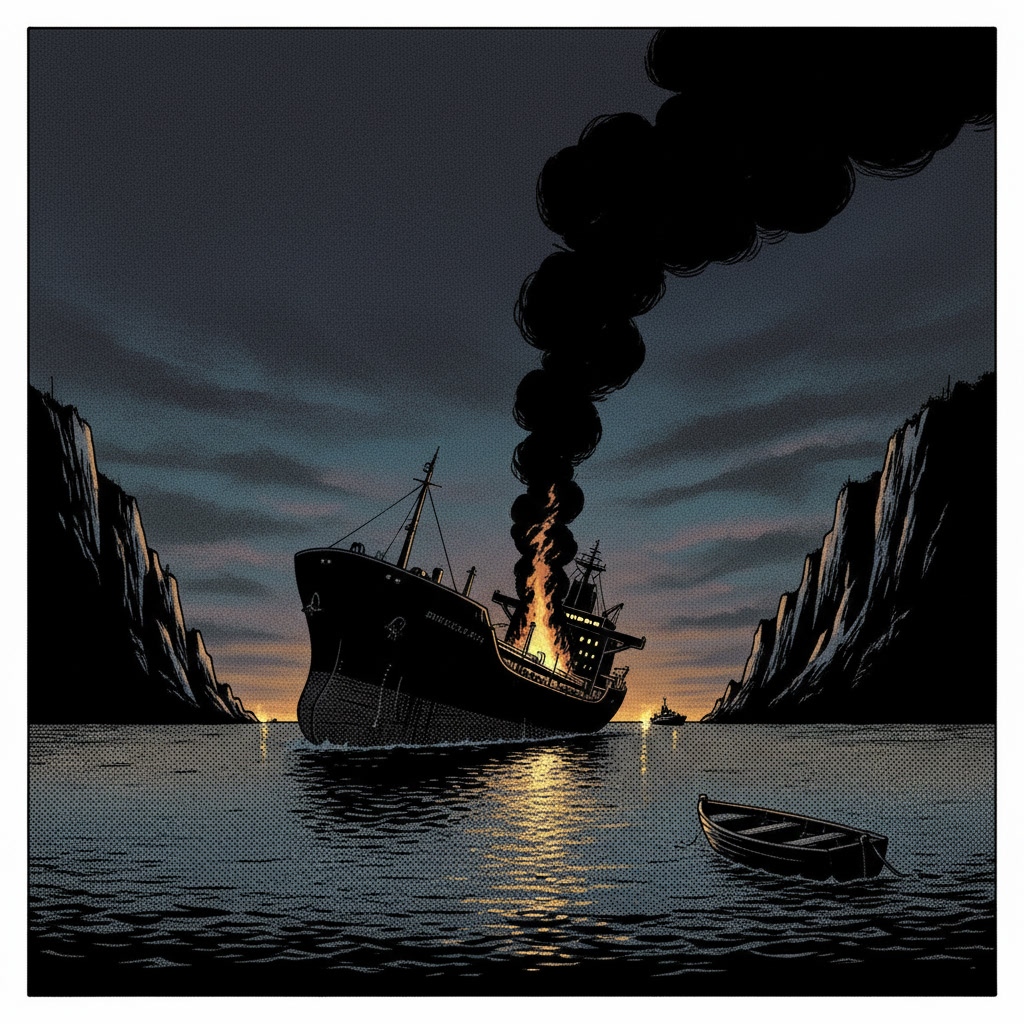
The United States struck multiple targets inside Iran. Iran struck back and threatened to close the Strait of Hormuz — the narrow passage through which roughly one-fifth of the world's seaborne oil transits every day. Bloomberg reported what appears to be an additional tanker attack in the Gulf of Oman, the body of water that forms the eastern mouth of that passage. And Trump told the world: deal by Thursday or face more. Today is Thursday.
The read here is this. The most instinctive historical comparison is Operation Praying Mantis — April 1988, when the US Navy sank two Iranian frigates, a guided-missile boat, and two offshore oil platforms in a single afternoon and Tehran backed down within weeks. But that comparison does not travel cleanly to today. In 1988, Iran was fighting a grinding, eight-year land war with Iraq; its military was exhausted; Ayatollah Khomeini was privately looking for a way out before the guns fell silent. None of those structural conditions exist now. Iran today is not fighting a second front. It retains meaningful escalatory tools that a depleted 1988 Iran did not: the capacity to mine Hormuz, the ability to direct proxy attacks on Gulf Arab infrastructure, and the unresolved nuclear program as a strategic reserve of leverage. The historical parallel that actually fits is not 1988's resolution but 1988's opening sequence — each American action producing an Iranian response designed to prove it cannot be coerced, which produces the next American action. That cycle has its own momentum once it starts.
What I'd watch for next, with the falsifier: the critical variable today is not the ordnance — it's Oman. Yesterday's brief flagged that Oman's back-channel role has become publicly visible, which reduces its usefulness. If Muscat produces any signal before the New York close today — even a deliberately vague communiqué — the ultimatum is functioning as a negotiating instrument and the de-escalation architecture is still intact. If Muscat stays silent through today, the framework has no operational plumbing, and the next round of strikes becomes the only channel of communication. The tanker attack is the second variable: if it is confirmed as Iranian-directed, Hormuz mining becomes the next threshold event. If unattributed, the market will price Iranian intent regardless — and that pricing will be wrong in ways that matter.
Three other things worth knowing
China will be at the G7 trade table. Bloomberg reports China's Vice Premier is joining French President Macron's G7 call on trade imbalances — an unusual configuration that places Beijing formally inside a conversation historically organized around Western coordination. German Chancellor Friedrich Merz simultaneously called for stronger EU trade instruments against Chinese overcapacity, even as Brussels describes its current posture toward China as a strategic "reset." The read here: Europe is running two postures in parallel — inviting Beijing into governance forums while building defensive trade tools against it. China has been exploiting that gap for three years and is demonstrably getting better at it.
Turkey is threatening a "strong response" to France and Cyprus. Bloomberg reports Ankara's warning after Paris and Nicosia formalized a bilateral defense agreement. Cyprus is an EU member but not a NATO member — which makes France extending a defense commitment there a pointed act in Turkish eyes, given the unresolved partition of the island and Turkey's own alliance standing. Romania's premier-designate also failed this week to secure his governing coalition, per Bloomberg. The read here: NATO's internal fault lines are accumulating stress from multiple directions simultaneously, at exactly the moment external alliance credibility matters most.
China placed a new signals intelligence satellite in geostationary orbit this morning. A Long March 5 rocket lifted off from Wenchang at 7:30 a.m. local time and placed TJSW-25 — the 25th in China's Tongxin Jishu Shiyan Weixing series — into geostationary transfer orbit. Beijing describes the series as "communication technology test satellites." Western defense assessments have consistently characterized TJS (Tongxin Jishu Shiyan) platforms as signals intelligence antennas designed to collect radio-frequency emissions from a permanently fixed position over a fixed patch of Earth. Geostationary means it doesn't move relative to the ground below it; whatever swath of the planet it watches, it watches continuously. The Celestrak tracking catalog also logged four new Qianfan broadband satellites today — China's Starlink competitor, now past 160 active objects in orbit.
Echoes
Operation Praying Mantis, April 18, 1988, is the right case to put on the table — not because it repeats, but because understanding why it won't repeat clarifies today's situation. The US Navy's one-day destruction of Iranian naval capability in the Gulf produced a swift Iranian stand-down, but only because Iran's decision calculus that spring was dominated by exhaustion: the Revolutionary Guard had fought Iraq for eight years, and Khomeini accepted a UN ceasefire less than three months after Praying Mantis, ceasing a war he had once called a religious obligation. The lesson of 1988 is not "American strikes in the Gulf produce Iranian compliance." The lesson is "American strikes produce Iranian compliance when Iran has no escalatory room left." Today's brief cannot yet answer how much room Tehran actually has. That question is not rhetorical, and the answer will determine how long this sequence runs.
The quiet things
Bank of Japan Governor Kazuo Ueda remains hospitalized for a second day with no policy clarification from his deputy governor. Yesterday's brief named the falsifier: a statement clarifying continuity before the Tokyo close would close the variable; its absence is not neutral information. The absence held through another session. The yen carry trade — the vast structure of borrowing cheap yen to invest in higher-yielding assets elsewhere — continues to price continuity on assumption rather than on evidence. The read here: that is not a small thing. The Iran exchange has consumed the wire entirely; the Bank of Japan story is moving down every ranking. That is not a reason to stop watching it.
The IAEA (International Atomic Energy Agency) review of Iran's uranium accounting, which yesterday's brief flagged as still unresolved, has produced no public update today. The kinetic exchange and the arms-control process are now running in the same physical and political space — which is precisely when the arms-control process most needs monitoring. What I'd watch for next: if the IAEA flags a material accounting discrepancy while Washington is mid-ultimatum, the architecture of the nuclear file changes in ways the military track cannot simply ignore.
How I'd act on this
If you trade energy or shipping — the Hormuz threat is the variable to size today. Tanker insurance premiums on Gulf-origin cargoes, the Brent-WTI differential, and crude options positioning will move before most equity positions adjust. Bloomberg's tanker attack report, if confirmed as Iranian-directed before today's close, is the repricing trigger. Watch the New York session.
If you hold yen-denominated positions or anything correlated with Japanese rate expectations — this is a second consecutive day without a Bank of Japan clarity statement. The Tokyo afternoon session is the next read; absence of a statement from the deputy governor is not neutral.
If you cover NATO or European security — read the France-Cyprus pact and Turkey's response alongside Romania's political stalemate. The alliance is absorbing simultaneous internal stresses at a moment when its external credibility is structural to the Western position on both Iran and Ukraine. These do not cancel each other out; they compound.
If you're watching the Iran nuclear file directly — the IAEA review deserves a second window, separate from the military wire. The two tracks are not independent, and the moment they interact is the moment the escalation architecture changes most sharply.
Trump's Thursday deadline produced its answer this morning: a tanker attack in the Gulf of Oman and a threat to close Hormuz.
Tehran's reply to the ultimatum was a burning hull in the Gulf of Oman and a hand on the Hormuz valve — not a phone call to Muscat.
— *The Plumb Line*. Daily world brief.
Sources
US-Iran / Hormuz / tanker attack
- newswire/ft — "FirstFT: Iran threatens Hormuz after renewed US strikes," June 11
- newswire/nyt — "Iran War Live Updates: U.S.-Iran Strikes Risk Dangerous New Phase," June 11
- newswire/bloomberg — "US Strikes 'Multiple' Targets in Iran," June 11
- newswire/bloomberg — "Trump Vows More Strikes on Iran Thursday If It Holds Out on Deal," June 11
- newswire/bloomberg — "Another Tanker Appears to Have Been Attacked in Gulf of Oman," June 11
- newswire/ft — "US and Iran exchange fresh wave of strikes," June 11
G7 / China / trade
- newswire/bloomberg — "China Vice Premier to Join Macron's G7 Call on Trade Imbalances," June 11
- newswire/bloomberg — "Merz Calls for Stronger Trade Tools as EU Seeks Reset With China," June 11
Turkey / NATO / Romania
- newswire/bloomberg — "Turkey Threatens Strong Response to France-Cyprus Defense Pact," June 11
- newswire/bloomberg — "Romanian Premier-Designate Suffers Setback as Deadline Nears," June 11
China space / satellites
- launch_library/2670e4f1-d58b-4787-9c3f-f9eb03349513 — Long March 5 | TJSW-25, Wenchang, June 11, launch successful, geostationary transfer orbit
- celestrak/69235 — TJS-24, newly cataloged June 10
- celestrak/69114, 69115, 69083, 69121 — Qianfan 155, 156, 137, 162, newly cataloged
Bank of Japan / Ueda (continuity from June 10)
- newswire/ft — "BoJ governor Ueda hospitalised," June 10; no update reported June 11
Historical references
- Operation Praying Mantis, April 18, 1988: US Navy action against Iranian naval forces in the Persian Gulf
- Iran-Iraq War ceasefire, August 1988: Khomeini's acceptance of UN Resolution 598, three months after Praying Mantis